Burgundy Velvet Lehenga for Winter Weddings: Bazaar Style Guide
How to wear a light burgundy velvet lehenga choli at winter weddings: why velvet suits the cold months, burgundy vs...
How to wear a light burgundy velvet lehenga choli at winter weddings: why velvet suits the cold months, burgundy vs...
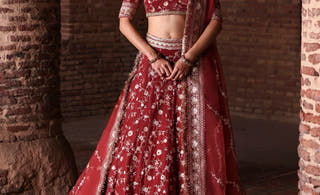
Pakistan's biggest wedding season falls between November and February, when shaadi tents go up on cold lawns and the guest list arrives in shawls. The same months bring winter weddings in Birmingham, Toronto and Chicago. Chiffon and net look lovely in October, but by December a bride wants something with weight, warmth and colour that holds under evening lights. That is where velvet comes in.
Bazaar is our light burgundy velvet lehenga choli, made for exactly these weddings. This guide covers why velvet suits the cold months, how burgundy compares with classic bridal red, how Bazaar is made, and how to wear it at a Pakistani Muslim, Sikh or Hindu wedding, as the bride or as part of her family, at home or abroad.

| Colour | Light burgundy, a warm red with a wine undertone |
| Fabric | Micro Velvet 9000 lehenga and choli; sheer organza dupatta |
| Embroidery | Floral and vine embroidery in metallic thread with small embellishments and mirror accents; heavily worked hem and waistband |
| In the set | Lehenga, choli and organza dupatta (3 pieces) |
| Price | Rs.160,000.00 for the full set |
| Sizes | XS–XL standard, or custom-stitched to you |
| Making time | About 4 weeks, then free tracked shipping worldwide |
Velvet has a short, dense pile that traps a little air, so it feels noticeably warmer than silk or chiffon while still sitting close to the body. On a December night under a marquee, that difference means you can leave the shawl in the car for the photographs and still be comfortable when the heaters cannot keep up.
The pile catches light at different angles as you move, so the colour looks deeper in the folds and brighter on the surface. Under warm stage lights it reads soft and luxurious rather than shiny, and metallic embroidery stands out sharply against it, which is why velvet looks so good in both wide shots and close-ups.
Bazaar is cut in Micro Velvet 9000, a fine velvet with a smooth hand and a heavy, fluid fall. It lets the lehenga swing rather than stand stiff, and it keeps its shape through a long evening of sitting, standing and dancing.

Classic bridal red is bright and celebratory; burgundy pulls that red towards wine. Light burgundy, the shade of Bazaar, sits between the two. In daylight it is clearly a red, and by evening it settles into a deeper, more romantic tone, so it reads as bridal without being identical to every other red outfit in the room.
It flatters a wide range of skin tones. Fair skin gains warmth and contrast, while wheatish and deeper complexions look luminous against it, especially with gold jewellery. If you love red but want something a little more unusual, or you are a sister or cousin who wants to wear red tones without matching the bride, light burgundy is a graceful answer.
Fine floral and vine embroidery in metallic thread climbs the whole lehenga, lit by small embellishments and touches of mirror work. From across the hall it looks like an even shimmer; up close you can follow each vine and bud.

The skirt ends in a wide, heavily embellished border that adds weight to the hem and helps the velvet flare when you turn. A matching ornate band frames the waist, so the lehenga looks finished whether the dupatta is draped over it or not.
The choli has a V neckline outlined in embroidery and elbow-length sleeves with a worked edge, with the same floral vines across the body. The V shape is ideal for layered necklaces, and the sleeves give a little extra cover on cold nights.

The dupatta is a sheer organza in the same shade, scattered with florals and framed by a heavy border on all four sides with fringed edges. Its lightness balances the weight of the velvet, and it falls beautifully as a veil.

Because Bazaar belongs to the red family, it fits more ceremonies than most coloured lehengas. Here is how it works across three traditions.
| Tradition | For the bride | For family and guests |
| Pakistani Muslim | Nikkah, mehndi or walima; a lighter baraat look | Baraat, walima, dholki and qawali night |
| Sikh | Jaago, reception, or a softer Anand Karaj look | Anand Karaj with head covered, jaago, reception |
| Hindu | Sangeet, reception, or a pheras look in red tones | Sangeet, cocktail, reception |
For a nikkah, bring the organza dupatta forward over your hair so the heavy border sits around your face; the V neckline leaves room for a delicate necklace and a matha patti. For the walima, a bride can let the velvet do the work with one statement set. A bride who finds a full heavy bridal too much for the baraat can wear Bazaar with heavier jewellery and a second dupatta pinned across the shoulders.
Red and its deeper shades are long-standing choices for the Anand Karaj, so Bazaar suits a bride who wants a lighter look than a traditional heavy lehenga, as well as her family. In the gurdwara your head stays covered, and this organza dupatta has the length to cover your hair and still fall down one side. At the jaago, open the dupatta across both arms so the skirt can move as you dance.
Red tones are traditional for the pheras, and a bride can wear Bazaar there with a kundan or polki set and chooda. For the sangeet and reception, guests can wear it with long earrings and the dupatta folded over one arm for dancing.

A velvet lehenga already does a lot of the work, but outdoor functions in a Lahore December or a British January can still be chilly. A few practical ideas:
Warm gold is the natural partner for burgundy. Polki and kundan look regal, layered gold necklaces suit the V neckline, and rubies or garnets echo the shade of the velvet. Silver can work for a guest but cools the outfit down.
For hair, a low bun keeps the neckline and the back of the choli on show, while soft waves suit a nikkah look under the dupatta. On the face, a warm base, bronze or copper eyes and a berry, brick or deep rose lip all sit well against the wine undertone. Very pale lips can look washed out next to deep red.

| Design | Feel | Best for |
| Light burgundy velvet (Bazaar) | Warm red with a wine undertone | Nikkah, mehndi, baraat, winter receptions |
| Dark green velvet (Taseer) | Deep, jewel-toned green | Mehndi and winter evening functions |
| Teal velvet (Manzil) | Turquoise-teal velvet with a rich sheen | Walima, engagement and December receptions |
| Red bridal (Simran) | Classic bridal red | Baraat, pheras and Anand Karaj |
See every velvet design together in our Velvet Allure collection.
A large share of our velvet orders go overseas, because a December wedding in Manchester, Toronto or New Jersey calls for exactly this kind of fabric. Brides in Dubai often choose velvet too, since wedding halls there run cold with air conditioning. For Sydney or Melbourne, plan around a June or July date, when it is winter in Australia.
Velvet rewards a little care. Hang the lehenga on a wide hanger rather than folding it tightly, so the pile is not crushed. If creases appear, steam lightly from the reverse and never press an iron flat onto the face of the velvet. Store it in a breathable cloth bag in a dry wardrobe, and wrap the organza dupatta separately so its border does not mark the velvet. For cleaning, use a specialist dry cleaner and point out the embroidered areas.

Rs.160,000.00 covers all three pieces. Order on the Bazaar product page.
Yes. Light burgundy reads as a red, so it suits a nikkah and works for a bride who wants a lighter baraat look than a full heavy bridal.
It is at its best from November to February in Pakistan and for winter weddings abroad. For a daytime outdoor function in summer, a silk or chiffon design will be more comfortable.
Yes. The price covers all three pieces: lehenga, choli and the embroidered organza dupatta.
Making takes around four weeks. After dispatch, orders inside Pakistan reach you in 2 to 5 days and international orders in 4 to 11 days, shipped free with tracking. Getting close to your date? Talk to us on WhatsApp before you place the order.
Because each Bazaar set is stitched for you, we cannot accept returns for a change of mind. You can ask to cancel within 24 hours of ordering; if approved, a 6% fee applies. Anything that reaches you damaged or wrong should be reported within 5 days, with photos, and we will fix it. Full details are in our Refund Policy.
Visit our studio at 39-A MM Alam Road, Block B1, Gulberg III, Lahore. Hours are 11am–9pm Monday to Saturday and 3pm–9pm on Sunday. No appointment is needed to drop in, though brides are advised to book one. Questions first? Message us on WhatsApp: +92 310 0001250.
Shop Bazaar, or browse Velvet Allure, Pakistani Nikkah Dresses, Pakistani Mehndi Dresses and Reception and Walima Dresses. Dressing for several events? Our function-by-function wedding dress guide can help, and our measuring guide shows how to size a custom order.
Cart
Your cart is currently empty.
Start ShoppingSelect options