Dark Green Velvet Lehenga: How to Wear Taseer from Winter Mehndi to Nikkah
A near-black green velvet lehenga with gold zari and an ivory tissue dupatta: how Taseer by Waqas Shah is made,...
A near-black green velvet lehenga with gold zari and an ivory tissue dupatta: how Taseer by Waqas Shah is made,...
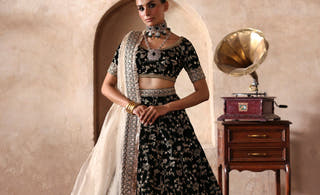
Winter weddings ask more of an outfit. Functions move outdoors after sunset, lawns turn cold by ten, and photographs are lit by fairy lights and flash rather than sunshine. Pale chiffon and net can look washed out in that light; a deep velvet does the opposite, soaking up the colour and letting gold embroidery shine on top.
Taseer is our dark green velvet lehenga choli, designed for exactly those December and January nights. It pairs a near-black forest green base and a gold zari jaal with a light ivory tissue dupatta, so the look is rich without feeling heavy. This guide explains how it is made, how to choose between the greens in our collection, and how to wear it from a winter mehndi to a nikkah, at Pakistani, Indian and Sikh weddings, as the bride, her sister or a guest.

| Colour | Deep forest green that turns almost black by evening light, with gold embroidery and an ivory dupatta |
| Fabric | Velvet lehenga and choli; tissue dupatta |
| Handwork | Floral vine jaal in gold zari and tilla with sitara; wide hem border in dabka, beads and zari |
| In the set | Three pieces: lehenga, choli and dupatta |
| Price | Rs.175,000.00 for the full set |
| Sizes | XXS to XL, or made to your measurements |
| Making time | Around 4 weeks, then free tracked shipping worldwide |
From waist to hem, the lehenga is covered in a jaal of small flowers, open blossoms and curling vines, worked by hand in gold zari and tilla. Tiny gold leaf shapes and sitara are scattered between the stems, so the pattern catches light from every angle without ever turning into solid metal. Because the velvet underneath is so dark, the gold reads clearly from across a room and in long-distance photos.
Around the bottom runs a wide border built up in dabka, beads and zari, heavier than the jaal above it. That weight is deliberate: it pulls the velvet down so the skirt falls in full, even folds and swings when you walk. A narrower worked band at the waist echoes the border and gives the outfit a neat, finished line where the choli meets the lehenga.


The velvet choli repeats the floral jaal, with a round neckline edged in gold and a worked border at the hem. Its elbow-length sleeves end in broad embellished cuffs, which frame stacked bangles beautifully. At the back the choli dips low and ties with a dori, finished with gold latkans that hang just above the lehenga, a detail worth showing off in photos.


Most dark lehengas come with a dupatta in the same shade. Taseer breaks that rule on purpose. The light ivory tissue, scattered with fine bootis and bordered on all four sides, brings light up to the face, softens the depth of the velvet and stops the outfit from looking heavy on a small frame. Tissue also has a natural sheen, so under flash it glows rather than going flat. Drawn over the head for a nikkah or pinned on one shoulder for a mehndi, it gives two very different looks from the same set.
Green is the most requested colour for a Pakistani mehndi, and our collection carries several shades. A quick way to choose:
| Shade | Feel | Best for |
| Dark green velvet (Taseer) | Deep, regal, almost black at night, with an ivory contrast dupatta | Winter mehndi, nikkah, walima, evening events |
| Dark green with mirror work (Shah Bano) | Festive and sparkling | Mehndi and dholki dancing |
| Emerald (Shahrbanu) | Bright jewel tone | Daytime mehndi and mayun |
| Bottle green (Mehar Bano) | Colourful resham over sequins | Dholki to nikkah, sisters and guests |
| Teal velvet (Manzil) | Blue-green, cool and modern | Winter walima and engagement |
If you want the warmth of velvet but a more traditional mehndi green, Taseer is the darkest and most formal of the group.
For a bride, an evening mehndi in December is where Taseer feels most at home. Pin the ivory dupatta on one shoulder, wear a heavy kundan choker with emerald drops and add green and gold glass bangles. The dark base stands out beautifully against a yellow or marigold stage.
Keep the jewellery to one choker or a pair of chandbalis and fold the dupatta over one arm. In candlelight the zari jaal glows softly, and the velvet keeps you warm through a long outdoor evening.
Draw the ivory dupatta over your head and let its border frame your face, with a simple tikka and pearl drops. Brides who want something other than red or white for their nikkah often choose a deep green; for the bride's sisters and mother it is an elegant, understated choice.
For a ring ceremony or a winter walima, go more polished: a side parting or sleek bun, a statement necklace and the dupatta pinned neatly so the cuffs and latkans show. Dark green photographs well next to a groom in ivory, black or gold.

Deep velvet is just as popular at North Indian and Punjabi winter weddings. As a rough guide:
| Wedding | For the bride | For family and guests |
| Hindu | Sagai, mehendi night, sangeet, cocktail and reception | Every evening function |
| Sikh | Roka, jaago and the reception | Every function, including the Anand Karaj |
Red and pink still lead at the pheras and the Anand Karaj, and yellow at the haldi and maiyan, so on those days Taseer suits the mother, sisters and friends of the bride rather than the bride herself.
Choose a full polki or kundan set with emerald and uncut stones, a jhoomar or matha patti, and the dupatta over the head. Warm bronze eyes and a brick or berry lip suit the velvet.
Wear one statement piece, either a choker or heavy jhumkas, and pin the dupatta on one shoulder so the back of the choli shows when you dance.
Go light: gold studs, a single kara and the dupatta folded over one arm. You will look dressed for the occasion without competing with the bride.
Prices on our site show in your local currency as an estimate, and payment at checkout is in Pakistani rupees. Choose any size from XXS to XL, or select Customize and send us your measurements; the size chart is on the product page and our team can help on WhatsApp. Taseer takes around 4 weeks to make in our Lahore atelier, then 2 to 5 days to arrive within Pakistan or 4 to 11 days internationally by tracked courier, shipped free. Our country guides cover duties and sizing for the USA, the UK, Canada, Australia, the UAE and Europe.
Rs.175,000.00 for all three pieces: lehenga, choli and dupatta. See it on the Taseer product page.
Velvet is best for the cooler months and evening events. In a heated or crowded hall it can feel warm, so most brides choose it for outdoor winter functions and keep lighter fabrics for summer weddings.
Both. Brides wear it for a winter mehndi, nikkah, engagement or walima, and sisters, cousins, bhabhis and friends wear it to every function.
Yes. It suits the sangeet, cocktail night, roka, jaago and reception, and for family and guests every ceremony.
Around 4 weeks to make, then 2 to 5 days within Pakistan or 4 to 11 days internationally, with free tracked shipping. If your date is close, message us before ordering.
Every piece is made to order, so change-of-mind returns are not available. Orders can be cancelled within 24 hours, subject to approval and a 6% fee. If an item arrives defective or incorrect, report it within 5 days of delivery with photos and we will put it right. See our Refund Policy.
Yes, at our Lahore studio, 39-A MM Alam Road, Block B1, Gulberg III, open 11am to 9pm Monday to Saturday and 3pm to 9pm on Sunday. Walk-ins are welcome; bridal appointments are recommended. WhatsApp +92 310 0001250.
Shop Taseer, or explore Velvet Allure, Green Mehndi Dresses and Pakistani Bridal Dresses. Planning the whole mehndi wardrobe? Read our mehndi lehenga guide for brides and sisters.
Cart
Your cart is currently empty.
Start ShoppingSelect options