Hot Pink Lehenga Guide: How to Wear Jasleen from Mehndi to Sangeet
How to wear a hot pink lehenga at a Pakistani, Indian or Sikh wedding: the difference between hot pink, rani...
How to wear a hot pink lehenga at a Pakistani, Indian or Sikh wedding: the difference between hot pink, rani...
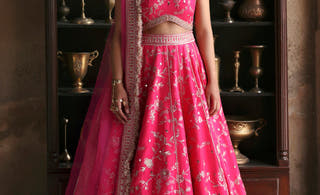
Hot pink is the colour of a wedding in full swing: dhol, mehndi cones, marigold strings and everyone on the dance floor. It is also one of the hardest shades to wear well, because it can look either radiant or loud depending on what you pair it with. This guide covers both. It uses Jasleen, a hot pink raw silk lehenga choli from our Shakuntala collection, to show how the colour works from the mehndi to the nikkah to the sangeet.

These names get mixed up, and the difference matters when you are matching jewellery or a groom's outfit.
Jasleen sits firmly in hot pink, and its gold and champagne embroidery pushes it slightly warm rather than purple.
Hot pink is at its best at lively, colourful events: the mehndi, dholki, sangeet and qawali night. It also makes a confident choice for a nikkah or engagement if you want something brighter than ivory or pastel. For the baraat itself, most brides still choose red, but hot pink is a natural pick for the bride's sisters and cousins on that day.
It suits almost every South Asian skin tone. On warm and wheatish skin it brings out a glow; on deeper skin it looks especially rich; on fair skin, a warmer pink like this one is kinder than a cool fuchsia. The gold embroidery helps here, because it puts a warm metal right next to the face.

The lehenga is covered in a floral jaal of tilla, resham and glitter sequins. Small teardrop mirrors sit between the vines, and round mirrors are set into the medallions of the wide keri hem border, so the skirt sparkles each time you move.

The sleeveless, high round-neck choli repeats the florals and mirrors. Its neckline, armholes and lower edge are finished by hand in pearls, seed beads, cut dana, crystal stones, Swarovski crystals and naqshi. At the back, gold doris end in a latkan of looped pearl rings.

Sheer pure organza scattered with glitter sequins, with a hand spray of pearls and beads at the centre, a broad keri border and a full gold tilla fringe. The fringe is what frames the face when the dupatta is worn over the head.
Stay in yellow gold: polki, kundan or jadau. Silver and oxidised pieces tend to look cold against this pink. A choker or rani haar with long jhumkas suits the high neckline. If you want a coloured stone, emeralds and pearls are the safest partners; rubies can work, but keep them small so they don't compete with the dress.
Let the skin glow and keep the eyes warm, in bronze, copper or soft gold. Choose a lip in rose, berry or a pink-nude; a bright pink lip on top of a bright pink lehenga is usually one pink too many.
A sleek low bun shows off the pearl latkan at the back. For the mehndi, a long braid with a parandi or fresh flowers is lovely.
Gold khussas or kolhapuris and a gold potli. A metallic clutch in silver can work as a single contrast piece if the rest stays gold.

Wear the dupatta over one arm or tied at the waist so you can dance freely. Glass bangles in pink and gold and fresh gajray suit the mood.
Pin the organza over your head so the tilla fringe falls around your face, and keep the jewellery to a choker, jhumkas and a delicate tikka.

This is where the mirrors earn their place under stage lights. Wear the dupatta over both shoulders and go a little bolder with the earrings.
Next to a bride in red, gold or ivory, hot pink looks festive and photographs well without matching her. Wear it with lighter jewellery and an open dupatta.
A Hindu bride can wear Jasleen for her sagai, mehendi, sangeet or reception, and her family can wear it for the haldi, lagan and pheras. At a Sikh wedding it suits the bride's roka, kurmai, chunni, jaggo and reception, and the family's maiyan and Anand Karaj. For the gurdwara, pin the organza securely so it stays in place as you sit.
If the couple want to match without twinning, put the groom in ivory, gold or champagne with a pink pocket square or a pink-and-gold stole. Pale mint or soft grey also pair well with hot pink. Avoid putting him in the same bright pink; it tends to flatten both outfits in photos.
Dry clean only. Store the lehenga flat or in a breathable cotton bag, with tissue paper over the mirror work so it doesn't scratch neighbouring fabric. Hang the dupatta rather than folding it, so the tilla fringe stays straight.
Each piece is made to order in 4 to 5 weeks, then shipped in 2 to 5 days within Pakistan, or 4 to 11 days to the USA, UK, Canada, Australia, the UAE and Europe. Allow at least seven weeks before your first function. Our measurement guide walks you through sizing, and our pages for the UK, USA and Canada cover delivery and customs.
Yes. It is a popular bridal choice for the mehndi, nikkah, engagement and sangeet. Many brides keep red for the baraat and wear hot pink for the functions around it.
Gold jewellery in polki, kundan or jadau, with emeralds or pearls if you want a coloured stone. Avoid silver if the embroidery is gold.
Mostly. Rani pink is the traditional South Asian name for bold, bright pinks, and hot pink falls within it. Fuchsia and magenta are cooler and deeper.
Ivory, gold or champagne, with a small pink accent. Mint and soft grey also work.
Yes, at our studio at 39-A MM Alam Road, Gulberg III, Lahore. Message us on WhatsApp first so we can have it ready.
View Jasleen or browse all our pink bridal lehengas. If you prefer a softer shade, see the salmon pink Avnoor, the tea pink Primrose or the blush pink Diyar. From the same Shakuntala collection, see the multicolour Neeru and the maroon Sargun.
Cart
Your cart is currently empty.
Start ShoppingSelect options