Maroon Bridal Lehenga for Baraat, Nikkah & Walima: Styling Sargun
How to style a maroon bridal lehenga for the baraat, nikkah, walima or mehndi at Pakistani, Sikh and Hindu weddings,...
How to style a maroon bridal lehenga for the baraat, nikkah, walima or mehndi at Pakistani, Sikh and Hindu weddings,...
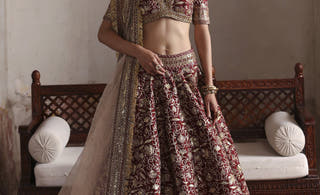
Red has always been the colour of the baraat, but the deeper side of red, maroon, is what many brides now choose for their biggest day. It reads richer under lights, flatters every skin tone and lets gold work glow. Sargun, the maroon lehenga choli from our Shakuntala collection, is cut in pure Indian raw silk and finished almost entirely by hand. This guide covers what goes into it and how to wear it, whether you are the bride or standing beside her.

Classic bridal red sits close to orange. Maroon carries a little brown and berry, so it looks deeper and calmer, especially in evening photographs. Gold tilla and sequins stand out more against it, and the colour works as well for a winter baraat as for a summer walima.
These three edges are worked by hand in pearls, seed beads, cut dana, crystal stones, Swarovski crystals, naqshi, tilla and resham. Cut dana has faceted sides that catch light at every angle, so the plunging V-neckline sparkles even by candlelight.

Small mirrors are fixed across the lehenga and choli with resham and tilla stitches, one at a time. They add a soft flash of light that sequins alone cannot give.
The gold doris at the back end in latkans and tassels made of gota, mirrors, golden pipe beads and gold patti. These are the details that show in every walking and back shot.

The dupatta is ivory pure Indian tissue in aari tilla, golden sequins and resham, sprayed by hand with pearls and Swarovski crystals. Its wide maroon border repeats the lehenga's embroidery without the mirrors, and pure copper kiran runs along all four sides.
Draw the dupatta over your head and pin it at the crown so the copper kiran frames your face. Polki or kundan with a long rani haar fills the deep V-neckline, and a matha patti completes the look.
Keep the jewellery softer: a choker with pearls and long jhumkis. The pearl and Swarovski spray on the dupatta shows best in close portraits, so let it rest lightly around the face.

Let the dupatta fall from one shoulder so the latkans stay on show. A sleek low bun, berry lips and gold khussas suit the evening.
At the mehndi, shendi or qawali night, swap gold for kundan with a pop of emerald, wear a long braid with gajra and let the dupatta hang loose from both arms. Keep the jewellery a size smaller than the bride's, and the look reads as festive rather than bridal.

Sargun suits the roka, kurmai, chunni ceremony, jaago, anand karaj and reception at a Sikh wedding, and the sagai, sangeet, phere and reception at a Hindu wedding. For the anand karaj, pin the dupatta in a few places, as you will sit and bow more than once, and the raw silk flare spreads neatly around you.
Dry clean only. Store the outfit in a breathable cotton bag with tissue paper between the worked panels. Roll the tissue dupatta rather than folding it so the kiran does not crush, and keep it away from perfume, which can dull copper over time.
Sargun takes about 4 weeks to make, then 2 to 5 days within Pakistan by TCS, or 4 to 11 days to the USA, UK, Canada, Australia, the UAE and Europe by DHL or SkyNet. Order at least six weeks before your first function. If you are between sizes, choose Customize and follow our measurement guide. Our guides for the UK, USA and Canada explain customs and delivery.
Deep maroon, richer and calmer than classic bridal red, with gold work throughout.
Yes. It is made as a bridal lehenga for the baraat, nikkah, walima and reception.
Yes. Sisters, cousins, bhabhis and friends wear it to the mehndi, shendi, qawali night and every other function.
The raw silk and the weighted sequin hem give it body, but it stays comfortable for a full evening of sitting, standing and dancing.
Yes, at our studio at 39-A MM Alam Road, Gulberg III, Lahore. Send a short message on WhatsApp before you come so we can have it ready.
View Sargun or browse our red bridal lehengas and Pakistani bridal dresses. Its sister pieces in Shakuntala include the red Simran, the skin gold Saanvi, the navy Geet, the salmon pink Avnoor and the multicolour Neeru.
Cart
Your cart is currently empty.
Start ShoppingSelect options