Navy Blue Bridal Lehenga: How to Wear Geet at Muslim, Sikh and Hindu Weddings
Navy blue works at more wedding functions than almost any colour. How Geet by Waqas Shah is made, and how...
Navy blue works at more wedding functions than almost any colour. How Geet by Waqas Shah is made, and how...
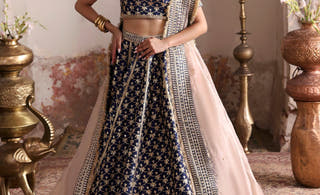
Some colours belong to one ceremony. Red to the pheras and the Anand Karaj, yellow to the mayun and haldi, green to the mehndi. Navy blue belongs to none of them, which is exactly why it travels so well. It is formal enough for a reception, festive enough for a sangeet, and it looks just as right at a Lahore mehndi as at a jaago in Southall or a reception hall in Toronto.
Geet is our navy blue bridal and formal lehenga choli from the Shakuntala collection. This guide explains what it is made of, when navy is the right choice, and how to wear it at a Muslim, Sikh or Hindu wedding, whether you are the bride, her sister or a guest, and whether the wedding is in Pakistan or abroad.

| Colour | Deep navy with gold embroidery and a champagne dupatta |
| Fabric | Pure Indian raw silk lehenga and choli; pure tissue dupatta |
| Handwork | Golden tilla aari jaal with sequins and resham; choli edges hand-embellished in pearls, crystal stones, sequins, naqshi and seed beads |
| In the set | Three pieces: lehenga, choli and dupatta |
| Price | Rs.165,000.00 for the full set |
| Sizes | XXS to XL, or made to your measurements |
| Making time | 4 to 5 weeks, then free tracked shipping worldwide |
Navy sits in a useful middle ground. It is darker and more formal than royal blue, softer than black, and it never competes with the bride's red. Gold embroidery stands out clearly against it, so a navy lehenga looks rich in photographs from across the hall as well as in close-ups. It also suits a wide range of skin tones: on fair skin it gives contrast, on wheatish and deeper skin it brings out warmth, especially with gold jewellery.
There is a practical side too. Evening functions are usually lit by warm stage lights and fairy lights, which can turn pale pastels flat and make bright colours look orange. Deep blue holds its colour under that light. And because it is not tied to one ritual, the same outfit can be worn by a bride at her mehndi, by her sister at the baraat and by a friend at the reception without anyone feeling out of place.
Raw silk has a slightly textured surface and a soft, natural sheen rather than a shine. It is heavier than chiffon or net, so the lehenga keeps its shape through a long night and the kalidar panels open into a full circle when you turn. That weight also makes it comfortable for cool evenings and air-conditioned halls.

The whole surface is laid with a lattice in golden tilla, worked with an aari hook and filled with small flowers in sequins and resham. Near the bottom the pattern changes into a broad band of paisleys, gold stripes and lines of sequins, which adds weight at the hem and gives the skirt its swing. Up close, you see each flower inside its diamond; from a distance, the jaal reads as an even gold shimmer over the navy.

The choli carries the same jaal, but its edges are finished by hand. Around the round neckline, the deep back and both hems, our karigars set pearls, crystal stones, sequins, seed beads and naqshi, a flat metallic wire that gives a crisp raised outline. The short sleeves end in a wide gold border. At the back, gold doris tie into a latkan made of gota, small mirrors and beads, a detail that shows best when the dupatta is pinned on one shoulder.


Instead of a second navy layer, the dupatta is a pale champagne tissue. It brings light up towards the face, keeps the look from feeling heavy, and catches the camera flash with a soft glow. Its border repeats the gold work of the lehenga, and a hand-embellished spray runs through the middle, so it looks finished whether it is worn over the head, across both arms or on one shoulder.
A Pakistani shaadi can run for a week, and navy fits more of it than most colours.
| Function | For the bride | For family and guests |
| Dholki and qawali night | A relaxed look with the dupatta over one arm | Yes |
| Mehndi | Yes, especially an evening or winter mehndi | Yes |
| Nikkah | Yes, for a bride who wants something other than red or white | Yes |
| Baraat | Most brides choose red | Yes, a strong choice for sisters and bhabhis |
| Walima | Yes, with lighter jewellery | Yes |
For the mehndi, navy stands out against a stage full of marigolds and yellow drapes, a fresh alternative to the classic green. For the nikkah, draw the champagne dupatta over the head so its border frames the face. For the walima, trade the bridal set for a single statement necklace and let the hand-embellished neckline do the work.

Punjabi weddings are built around music and dancing, and a lehenga with a full flare and a firm fabric is made for them.
| Function | For the bride | For family and guests |
| Roka and chunni | Yes | Yes |
| Maiyan | Brides usually wear yellow | Yes |
| Jaago | Yes | Yes, ideal for dancing |
| Anand Karaj | Most brides choose red or pink | Yes, with the head covered |
| Reception | Yes | Yes |
At the jaago, leave the dupatta open over both arms so the skirt can move freely as you dance with the decorated gaagar. For the Anand Karaj, family members and guests should keep the head covered in the gurdwara; the tissue dupatta is long enough to drape over the head and still fall over one shoulder. Pair it with a kara and gold bangles rather than anything too heavy for a daytime ceremony.

North Indian weddings follow a similar rhythm of evening celebrations around one sacred ceremony.
| Function | For the bride | For family and guests |
| Sagai or roka | Yes | Yes |
| Haldi | Brides usually wear yellow | Yes |
| Mehendi | Yes | Yes |
| Sangeet and cocktail | Yes, one of the best fits | Yes |
| Pheras | Most brides choose red | Yes |
| Reception | Yes | Yes |
The sangeet is where navy and gold shine brightest: stage lights, a dance floor and plenty of photographs. For a cocktail night, keep jewellery modern, with long earrings and no necklace, and wear the dupatta pinned or even folded over one arm. At the reception, a bride can go fully formal with a polki or kundan set and a side jhoomar.
Go for a layered look: a gold or kundan choker with a rani haar beneath it, a side jhoomar and a tikka, and gold bangles up to the elbow. Enter with the champagne dupatta over your head, then move it to your shoulders for the stage and photos.
Let your sister carry the heaviest jewellery and keep yours to a pair of large gold jhumkas or chandbalis with a slim necklace. A low bun or a braid with gajra keeps the open back and latkan in view when you dance.
Wear Geet with pearl or gold drop earrings, a ring and a slim kara, and carry the dupatta draped loosely over the elbows. Navy reads polished and celebratory, yet it never pulls attention from the bride's red or pink.

| Design | Feel | Best for |
| Navy raw silk (Geet) | Classic, formal, gold on deep blue | Mehndi, sangeet, jaago, reception |
| Midnight blue (Shahnaaz) | A softer blue, styled with silver and pearls | Evening mehndi, sisters and guests |
| Teal velvet (Manzil) | Blue-green velvet, warm and regal | Winter walima and engagement |
| Misty blue gown (Jhoomar) | Soft, open-front bridal gown | Walima and reception for the bride |
Many of our brides live outside Pakistan, and Geet is made with them in mind. Raw silk is a sensible choice for weddings abroad: it is warm enough for a UK or Canadian winter reception, and it holds its shape in the air-conditioned halls of the UAE and USA. If your wedding is in Australia, remember the seasons are reversed, so a June or July date there is a cool-weather wedding.
Rs.165,000.00 for the lehenga, choli and dupatta. See it on the Geet product page.
Yes. It is a popular choice for the mehndi, nikkah, sangeet, jaago and reception. For the baraat, the pheras and the Anand Karaj, most brides still wear red or pink, and navy becomes a lovely choice for their family.
Yes. Keep your head covered with the dupatta and choose lighter jewellery for a daytime Anand Karaj.
It is comfortable for evening functions, winter weddings and air-conditioned halls. For a long outdoor event in summer heat, a lighter fabric may suit you better.
4 to 5 weeks to make, then 2 to 5 days within Pakistan or 4 to 11 days internationally, with free tracked shipping. If your date is close, message us before ordering.
Every piece is made to order, so change-of-mind returns are not available. Orders can be cancelled within 24 hours, subject to approval and a 6% fee. If an item arrives defective or incorrect, report it within 5 days of delivery with photos and we will put it right. See our Refund Policy.
Yes, at our Lahore studio, 39-A MM Alam Road, Block B1, Gulberg III, open 11am to 9pm Monday to Saturday and 3pm to 9pm on Sunday. Walk-ins are welcome; bridal appointments are recommended. WhatsApp +92 310 0001250.
Shop Geet, or explore the Shakuntala collection, Reception and Walima Dresses and Pakistani Mehndi Dresses. Planning the whole week? Read our guide to what to wear for each wedding function or how to take your measurements.
Cart
Your cart is currently empty.
Start ShoppingSelect options